

Data Literacy Is Not a Training Program
Data Literacy Is Not a Training Program
It Is a Prerequisite for Digital Transformation
Data Literacy Is Not a Training Program. It Is a Prerequisite for Digital Transformation.
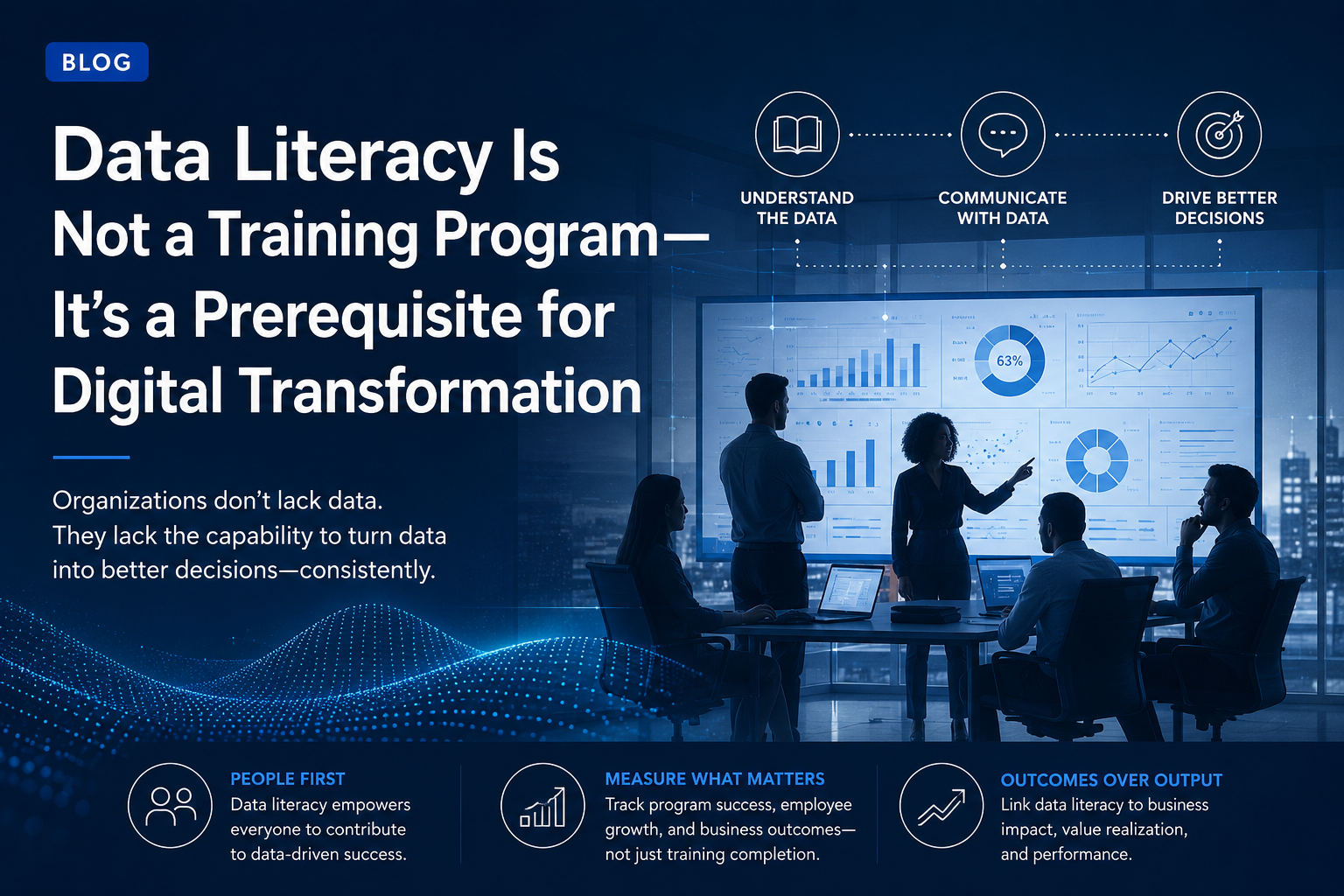
Most organizations do not lack data.
They have dashboards, reports, KPIs, BI tooling, data platforms, analytics teams and increasingly, AI pilots. Yet many still struggle to turn data into better decisions, faster execution and measurable business value.
That is the real problem.
Digital transformation does not fail because organizations have no data. It often fails because people, teams and leadership forums do not use data consistently to steer priorities, make trade-offs, challenge assumptions and measure outcomes.
Data literacy is therefore not a nice-to-have capability. It is one of the operating conditions for successful transformation.
From data availability to decision quality
For years, organizations have invested heavily in data and analytics. They have modernized platforms, centralized reporting, introduced dashboards and created specialist teams. But the business value of those investments is not automatic.
Gartner describes data literacy as the ability to read, write and communicate data in context, including an understanding of data sources, analytical methods, use cases and the resulting value. The key phrase here is in context. Data only becomes useful when people can interpret it within the reality of their work, their decisions and their business outcomes.
That is where many organizations get stuck.
They measure what is available, not always what matters. They report activity, not always impact. They create dashboards, but do not always create the decision rhythm around them.
The result is familiar: data is present in the organization, but not embedded in the way the organization thinks, prioritizes and acts.
Data literacy is change management
A common mistake is to treat data literacy as a training issue.
Training matters, of course. People need to understand data definitions, basic analytics, visualization, interpretation, bias, quality and the limits of metrics. But training alone does not change how decisions are made.
Data literacy is also about behavior.
It is about whether teams ask better questions. Whether leaders challenge assumptions with evidence. Whether portfolio boards look at value, risk, capacity and outcomes instead of only project status. Whether commercial, operational, IT and finance teams use the same language when discussing performance.
In that sense, data literacy is much closer to transformation and change management than to a standalone learning program.
It requires leadership, repetition, governance and practical application.
The missing link: business outcomes
The most important shift is this: organizations should not only ask whether people completed data literacy training. They should ask whether the organization is making better decisions because of it.
Gartner makes a useful distinction between three levels of measurement: the success of the data literacy program itself, the progress of employees, and the resulting business outcomes. That distinction matters because it prevents organizations from confusing training completion with value realization.
A data literacy initiative should therefore be connected to questions such as:
- Are we improving forecast accuracy?
- Are we reducing operational waste?
- Are we making faster portfolio decisions?
- Are we improving customer conversion, retention or service quality?
- Are we reducing risk by identifying issues earlier?
- Are management teams using the same data definitions when making decisions?
These are the questions that move data literacy from a capability initiative to a business transformation lever.
Why this matters for portfolio and transformation leadership
In complex organizations, transformation is rarely limited to one project. It involves multiple teams, competing priorities, scarce capacity, technology dependencies and changing business expectations.
That is exactly where data literacy becomes critical.
Portfolio steering only works when decision-makers can interpret data consistently. If teams report progress differently, define value differently or use KPIs without context, leadership forums become negotiation arenas instead of decision forums.
Good transformation governance depends on data-literate behavior.
Not because every stakeholder needs to become a data expert, but because every stakeholder needs to understand enough to make informed trade-offs.
- Which initiatives create the most value?
- Where is capacity constrained?
- Which risks are increasing?
- Which projects are consuming effort without sufficient return?
- Which benefits are real, and which are still assumptions?
Without data literacy, organizations can have portfolio dashboards and still lack portfolio control.
Data literacy and AI readiness
The rise of AI makes this even more urgent.
AI does not remove the need for data literacy. It increases it.
Organizations experimenting with AI need people who understand data quality, context, bias, governance, interpretation and accountability. If employees cannot critically interpret data, they will also struggle to critically interpret AI-generated outputs.
AI readiness is therefore not only about selecting tools or building technical capability. It is also about preparing the organization to ask better questions, assess outputs and connect insights to responsible business decisions.
In practice, the organizations that benefit most from AI will be those that already have a mature decision culture around data.
What leaders should do
Data literacy should not be positioned as an isolated learning track. It should be embedded in the operating model of transformation.
That means connecting it to the places where decisions are actually made:
- Strategy reviews.
- Portfolio boards.
- Quarterly planning.
- Performance dialogues.
- Customer journey reviews.
- Risk and compliance meetings.
- Management reporting.
- Transformation governance.
The goal is not to make everyone a data analyst. The goal is to make better use of data in everyday decision-making.
A practical approach starts with five steps.
First, identify the business outcomes where better data use would create measurable value.
Second, assess where decision-making currently breaks down because of poor data quality, inconsistent definitions or weak interpretation.
Third, define the data literacy capabilities needed by role. A board member, product owner, operations manager and analyst do not need the same depth of skill.
Fourth, embed data usage into existing governance rhythms, rather than creating a separate data initiative alongside the real business agenda.
Fifth, measure whether decisions, priorities and outcomes are improving.
That last point is essential. If the impact of data literacy cannot be connected to business value, it will remain vulnerable to budget pressure, executive fatigue and organizational drift.
The real transformation question
The question is not whether your organization has enough data. No, the better question is:
Does your organization have the capability to turn data into better decisions, consistently?
If the answer is no, then more dashboards will not solve the problem. More tooling will not solve it either. The organization needs to build the skills, habits and governance required to use data as part of how it actually runs.
That is why data literacy is not a training program.
It is a prerequisite for digital transformation, portfolio control and measurable business value.
Need help putting this into practice?
Turn AI ambition into governed, working processes, from pilot to controlled adoption.