
AI Leadership Digital Transformation | Why AI Projects Get Stuck on Leadership
Most AI projects do not fail because the technology is unavailable.
They fail because the organisation is not ready to change the way it works.
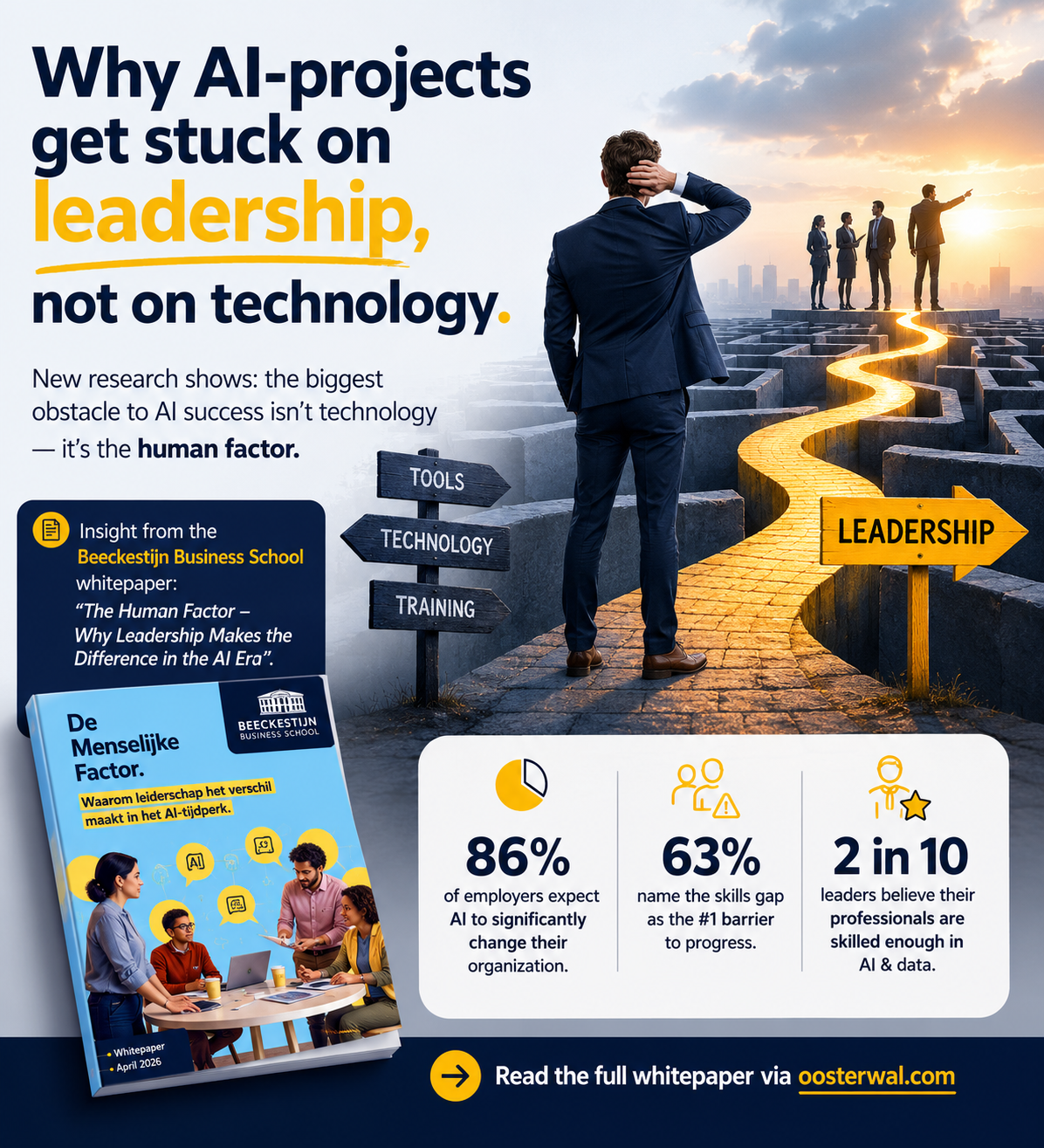
That is also the central point in Beeckestijn Business School’s recent whitepaper De Menselijke Factor: Why Leadership Makes the Difference in the AI Era. The report argues that while almost every organisation is discussing AI, far fewer are discussing the leadership required to make AI adoption successful.
And that is exactly where many AI initiatives get stuck.
The real bottleneck is not the tool
A familiar pattern is emerging.
An organisation selects an AI tool. A vendor presents the platform. A pilot is launched. Employees receive access, maybe a short e-learning, and leadership expects adoption to follow.
But then reality kicks in.
Some people try the tool and stop. Some do not understand how it fits into their work. Some are worried about what AI means for their role. Others continue using the old process because nobody has made clear what should change, what should stop, and what decisions are now expected at team level.
The technology may be available, but the organisation has not changed.
That is not a tooling issue. That is a leadership issue.
AI adoption requires choices
AI is often introduced as an efficiency opportunity, but in practice it creates hard management questions.
- What work should AI support?
- Which decisions remain human?
- Which processes can be simplified?
- What old reports, meetings or manual checks can be stopped?
- How do we prevent teams from simply adding AI on top of already overloaded work?
- Without clear choices, AI becomes another layer of complexity.
Leaders play a crucial role here. They need to create direction, set boundaries, make trade-offs and help teams understand what changes in daily work. That cannot be delegated to a tool, a vendor or an e-learning module.
The human skills become more important, not less
The Beeckestijn report makes an important point: as technology becomes more powerful, human capabilities become more valuable.
- Creativity, empathy, judgement, resilience and leadership are not side issues. They determine whether AI is used responsibly, effectively and sustainably.
- AI can produce answers. Leaders need to decide whether those answers are useful, ethical, commercially relevant and operationally workable.
- AI can accelerate work. Leaders need to make sure teams are not simply accelerating the wrong process.
- AI can support decision-making. Leaders need to create the conditions in which people dare to question, learn and adapt.
Control is not the same as leadership
One of the biggest risks in AI transformation is that uncertainty triggers more control.
- More reporting.
- More approval layers.
- More governance meetings.
- More detailed plans.
Some governance is necessary, especially around risk, data, compliance and accountability. But excessive control slows learning down. It makes people wait for permission. It prevents teams from experimenting. It creates the illusion of grip while the organisation itself becomes less adaptive.
Good AI leadership is not about letting go of responsibility. It is about creating clear direction and giving teams enough room to learn.
What leaders should do now
AI adoption becomes much more practical when leaders focus on five things.
First, understand the real starting point. How digitally mature is the team? Where is the resistance? Which skills are missing? What work is actually ready for AI?
Second, make time for learning. AI cannot be successfully adopted as “extra work”. If teams need to learn new ways of working, something else must be deprioritised.
Third, combine digital and human skills. Leaders do not need to become AI engineers, but they do need enough understanding to ask better questions and make better decisions.
Fourth, build psychological safety. People need to be able to say that they do not understand something, that a tool does not work for them, or that a proposed AI use case creates risk.
Fifth, measure behaviour and outcomes, not activity. The question is not how many people completed the training. The question is what changed in the way people work, decide and collaborate.
The conclusion
AI transformation is not primarily a technology programme.
It is a leadership challenge.
The organisations that benefit most from AI will not simply be the ones with the best tools. They will be the ones with leaders who can create clarity, build trust, make choices and help people move from experimentation to real adoption.
Technology may start the conversation.
Leadership determines whether anything actually changes.
Need help putting this into practice?
Turn AI ambition into governed, working processes — from pilot to controlled adoption.
Related services
- AI Process Implementation
- Strategic Diagnostic Session
- Business Transformation Framework — the structure behind the four services.