

De capaciteitenmindset: Hoe je bedrijfstransformatie herhaalbaar maakt
Bedrijfstransformatie is veranderd. Het is niet langer een episodisch “programma” dat je om de paar jaar uitvoert. Voor veel bedrijven is het nu een continue toestand. Uit een recent onderzoek van Forrester Consulting (in opdracht van SAP) blijkt dat bijna driekwart van de organisaties vier of meer bedrijfstransformatie-initiatieven per jaar ontplooit, en een aanzienlijk deel zelfs zes, negen of meer dan tien initiatieven per jaar.
En toch is het meest voorkomende faalpatroon niet veranderd: transformatie blijft gefragmenteerd. Strategieën worden niet omgezet in een gecoördineerde uitvoering, gegevens blijven in silo’s, bedrijfsmodellen drijven over functies en de organisatie verbrandt energie aan “activiteiten” zonder samengestelde resultaten. De boodschap van Forrester is onomwonden: de ambitie is hoog, maar de uitvoering is inconsistent, vooral omdat bedrijven transformatie behandelen als geïsoleerde projecten in plaats van als een herhaalbare, enterprise capability.
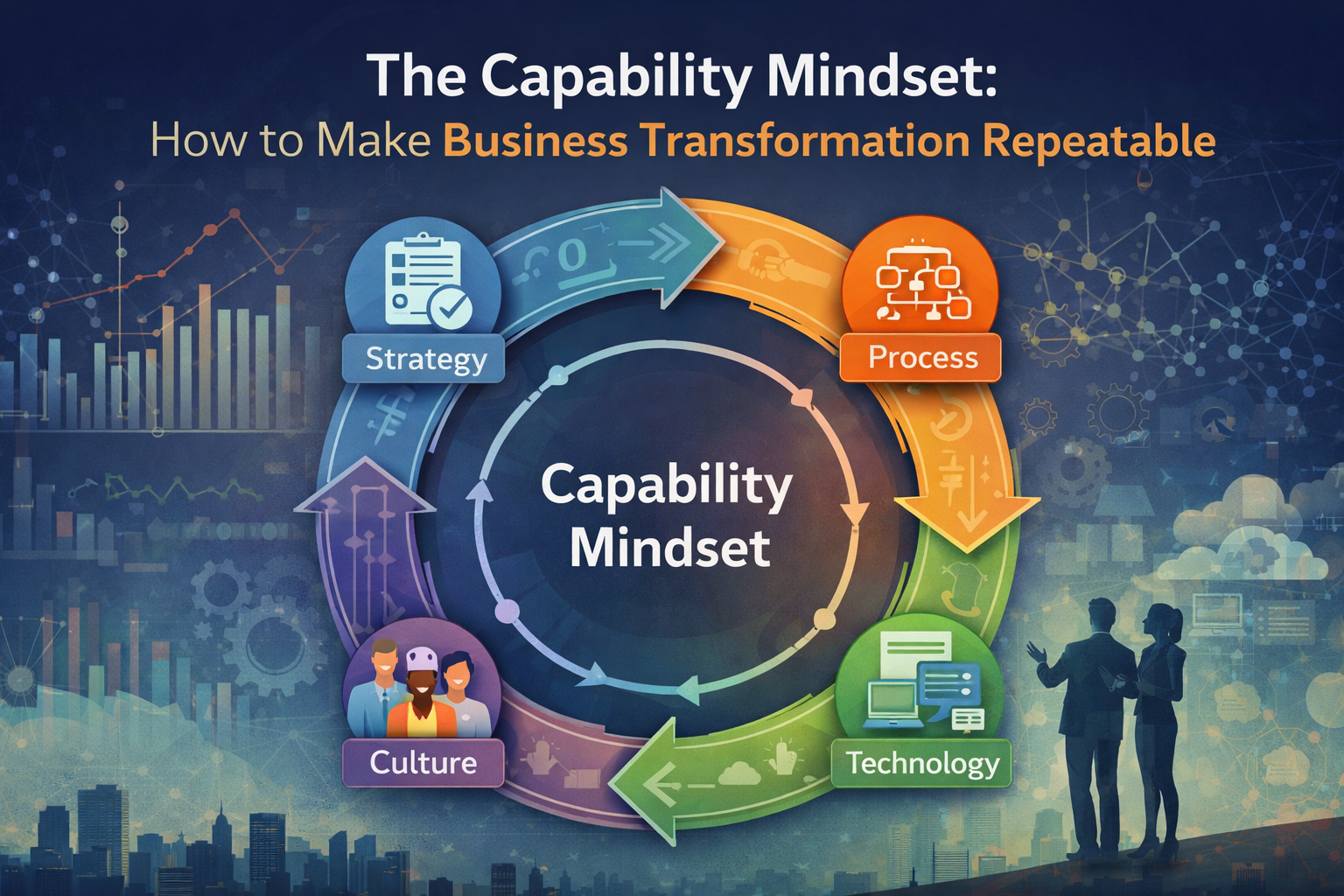
In dit artikel leg ik uit wat de “capability mindset” in de praktijk betekent, waarom de meeste transformatie-inspanningen er niet in slagen om op te schalen en hoe je een herhaalbare discipline opbouwt over vijf dimensies: strategie en leiderschap, processen, data, technologie en applicaties, en mensen en cultuur. Ik zal ook uitleggen hoe een lichtgewicht Portfolio MVP dit model snel kan omzetten in een operationeel stuursysteem, zonder overengineering.
Inhoud
- Wat is de capability mindset?
- Waarom transformaties gefragmenteerd blijven
- Hoe goed eruitziet: van basislijn tot doorbraak
- De vijf dimensies van een herhaalbaar transformatievermogen
- Operationeel model en bestuur: de ontbrekende mechanismen
- Gegevens als strategisch bedrijfsmiddel, niet “slechts een enabler”
- Eerst adoptie, dan hergebruik: hoe waarde zich vermenigvuldigt
- Hoe mijn Portfolio MVP dit echt maakt
- Een praktische checklist om volgende week mee te beginnen
- Volgende stap
Wat is de capability mindset?
Een capability mindset betekent transformatie behandelen als een herhaalbare discipline, niet als een eenmalig initiatief. In plaats van succes te definiëren als “het lanceren van een programma” of “live gaan”, definieert u succes als het hebben van een systeem dat continu strategie kan vertalen naar resultaten, cross-functionele uitvoering kan coördineren, waarde kan meten en kan leren en middelen kan hergebruiken voor verschillende initiatieven.
Forrester beschrijft transformatie als een strategisch bedrijfsmiddel en een “levende realiteit”. Maar het onderzoek benadrukt ook dat de meeste organisaties transformatie nog steeds op een gefragmenteerde manier benaderen, beperkt tot specifieke functies of technologie-upgrades. Het resultaat is tragere besluitvorming en het uitblijven van verwachte resultaten op schaal.
Met andere woorden, de capability mindset verschuift het gesprek van “Welk project zijn we aan het uitvoeren?” naar “Welke enterprise capability bouwen we die toekomstige veranderingen sneller, veiliger en goedkoper maakt?”.
Waarom transformaties gefragmenteerd blijven
Fragmentatie wordt zelden veroorzaakt door een gebrek aan visie. Veel leiderschapsteams zijn ervan overtuigd dat ze innovatie aanmoedigen en risico’s effectief beheren. De uitvoeringskloof wordt veroorzaakt door ontbrekende mechanismen: zwak bestuur, inconsistente KPI’s, onduidelijk eigenaarschap en beperkte zichtbaarheid in hoe initiatieven met elkaar verbonden zijn binnen de onderneming.
Forrester ontdekte bijvoorbeeld dat slechts ongeveer een kwart van de organisaties een cross-functionele bestuursraad voor transformatie heeft, transformatiedoelen verankert in KPI’s voor senior leiders of een routekaart voor legacymodernisering bijhoudt. Dat is een enorm signaal: de mindset is er misschien wel, maar het systeem niet.
Hetzelfde onderzoek belicht veelvoorkomende uitdagingen op het gebied van strategische afstemming:
- Slechte cross-functionele communicatie over transformatiedoelen (door 55% genoemd als zeer of zeer uitdagend).
- Strategie niet gecommuniceerd door de organisatie (51%).
- Concurrentie om budget tussen strategische initiatieven (50%).
- Onvoldoende follow-up en optimalisatie-inspanningen (50%).
Mijn interpretatie: dit is falend portfoliomanagement in slow motion. Wanneer doelen niet worden vertaald in een samenhangend portfolio met duidelijke afhankelijkheden, financieringslogica en resultaatmetrieken, wordt elk initiatief “belangrijk” en geen enkel initiatief is samenhangend.
Hoe goed eruitziet: van basislijn tot doorbraak
De studie van Forrester stelt een transformatievolwassenheidsreis voor met vier niveaus: beginner, gemiddeld, gevorderd en leider, beoordeeld op vijf dimensies. Leiders behandelen transformatie als een continue capaciteit, met een sterke afstemming tussen bedrijf en technologie en meer consistente governance en meting.
Cruciaal is dat slechts een klein deel van de organisaties op “leider”-niveau werkt. De meeste zijn nog steeds bezig met het opbouwen van basisvaardigheden en hebben moeite om op te schalen. Dat is geen reden om pessimistisch te zijn. Het is een reden om doelbewust en systeemgericht te werk te gaan.
Leiders doen een paar dingen anders:
- Ze splitsen meerjarige trajecten op in stapsgewijze, resultaatgerichte fasen met bestuurlijke controlepunten.
- Ze verschuiven de aandacht van “projecten” naar adoptie, hergebruik en orkestratie.
- Ze verankeren transformatie in operationele cadans, KPI’s en verantwoording.
De vijf dimensies van een herhaalbaar transformatievermogen
Als je wilt dat transformatie herhaalbaar wordt, moet je tegelijkertijd bekwaamheid opbouwen in vijf dimensies. Een ervan behandelen als “de hoofdfocus” en de andere als “later” is wat fragmentatie veroorzaakt.
1) Strategie en leiderschap
Strategie wordt pas echt als het wordt omgezet in een geprioriteerde, gefinancierde portfolio en als het wordt gecommuniceerd als een samenhangend verhaal over alle functies. Forrester merkt op dat organisaties worstelen met slechte cross-functionele communicatie van transformatiedoelen en ineffectieve strategiecommunicatie.
Praktische bewegingen:
- Definieer resultaatverklaringen (geen activiteitenverklaringen) voor elk initiatief.
- Vertaal uitkomsten in een kleine set portfolio KPI’s en beslissingsrechten.
- Creëer één enkele bron van waarheid: één portfoliooverzicht dat leiders vertrouwen.
2) Proces
Proces is waar transformatie vaak als eerste doorbreekt. Uit het onderzoek komt naar voren dat een slechte afstemming tussen bedrijfsprocessen en IT een van de grootste uitdagingen is op het gebied van uitvoering, in combinatie met silo-eigendom en een gebrek aan real-time monitoring.
Praktische bewegingen:
- Identificeer een klein aantal end-to-end “waardestromen” die het belangrijkst zijn.
- Wijs proceseigenaarschap toe en dwing cross-functionele verantwoordelijkheid af.
- Instrumentele processen: definieer meetbare flowmetriek, niet alleen output.
3) Gegevens
Forrester maakt een sterk punt: data is niet slechts een enabler, het is een strategisch bedrijfsmiddel. Slechte datakwaliteit, inconsistente masterdata en datasilo’s vormen de belangrijkste belemmeringen voor transformatiesucces, hebben invloed op de besluitvorming en beperken de waarde van opkomende technologieën zoals GenAI.
Praktische bewegingen:
- Definieer data-eigendom als onderdeel van het bedrijfsmodel, niet als IT-verantwoordelijkheid.
- Geef prioriteit aan een paar “vertrouwensdomeinen” (klant, product, activa, financiën) en repareer deze als eerste.
- Stel minimale gegevenskwaliteitscriteria op voor beslissingen en automatisering.
4) Technologie en toepassingen
Technologische schulden en integratiecomplexiteit beperken de snelheid. Forrester meldt dat meer dan de helft van de respondenten een hoge mate van technische schuld, datasilo’s en slechte datakwaliteit als belangrijkste technologiegerelateerde uitdagingen noemt.
Praktische bewegingen:
- Een moderniseringsdraaiboek bijhouden dat gekoppeld is aan resultaten en risicovermindering.
- Verminder architecturale variabiliteit waar deze hergebruik en standaardisatie in de weg staat.
- Ontwerp “platform”-mogelijkheden (API’s, gegevensproducten, identiteit, integratie) die meerdere initiatieven kunnen hergebruiken.
5) Mensen en cultuur
Cultuur is de onderscheidende factor. Het onderzoek toont aan dat leiders meer prioriteit geven aan vroegtijdige betrokkenheid van werknemers en toegewijde veranderings- en trainingsfuncties dan minder volwassen organisaties. Er wordt ook gewezen op werknemersmoeheid door voortdurende verandering, slechte communicatie over de transformatievisie en onvoldoende bijscholing als belangrijke uitdagingen op het gebied van mensen en cultuur.
Praktische bewegingen:
- Maak adoptie meetbaar: definieer adoptiedoelen per capability en monitor deze.
- Investeer in bijscholing die is afgestemd op het portfolio, niet in algemene trainingscatalogi.
- Gebruik verandering als product: communicatie, enablement en feedbackloops als onderdeel van de levering.
Operationeel model en bestuur: de ontbrekende mechanismen
De meeste mislukkingen op het gebied van transformatie zijn mislukkingen op het gebied van governance. Niet in de zin van “we hadden geen stuurgroep”, maar in de zin dat het de organisatie ontbrak aan een geïntegreerd mechanisme om strategie, financiering, prioritering, afhankelijkheden, risico’s en resultaten voor alle initiatieven te orkestreren.
Forrester geeft aan dat orkestratie het grootste gat in de capaciteit is: organisaties voeren initiatieven goed uit binnen afdelingen, maar missen een geïntegreerde bedrijfsstrategie. Dat gat zorgt voor dubbel werk, budgetgevechten, inconsistente standaarden en weinig hergebruik van middelen.
Als transformatie continu is, kan bestuur niet episodisch zijn. Het moet een cadans zijn:
- Maandelijks: portfoliobeoordeling (uitkomsten, risico’s, afhankelijkheden, middelen).
- Driemaandelijks: herprioritering en financieringsaanpassingen op basis van waardebewijs.
- Doorlopend: zichtbaarheid van prestaties, inzicht in adoptie en procesbewaking.
Gegevens als strategisch bedrijfsmiddel, niet “slechts een enabler”
Een van de sterkste onderdelen van het onderzoek is het gegevensargument: onbetrouwbare, gefragmenteerde gegevens zijn niet alleen een tactische ergernis. Het is een strategische beperking. Executives noemen de kwaliteit en integratie van data als een belangrijke factor die transformatieprojecten vertraagt of doet ontsporen.
Als je herhaalbare transformatiemogelijkheden wilt, heb je “beslissingswaardige gegevens” nodig. Dat betekent:
- Duidelijke definities (wat telt als “actieve klant”, “winst”, “tijdige levering”).
- Eigenaarschap (wie is verantwoordelijk voor kwaliteit en veranderingen).
- Toegankelijkheid (gegevens zijn bruikbaar waar beslissingen worden genomen).
- Governance (regels die snelheid mogelijk maken, geen bureaucratie).
Eerst adoptie, dan hergebruik: hoe waarde zich vermenigvuldigt
Er is een reden waarom Forrester de nadruk legt op adoptie en hergebruik. Transformatiewaarde bestaat alleen als mensen nieuwe mogelijkheden gebruiken in hun dagelijkse werk, en de waarde neemt toe als middelen worden hergebruikt voor verschillende initiatieven.
In het onderzoek rangschikten de respondenten de resultaten die in twee jaar de grootste impact zouden hebben. Aan de top: 90% gebruikersadoptie binnen 60 dagen door ingebed digitaal adoptiemanagement. Ten tweede: meer hergebruik van bedrijfsmiddelen (API’s, processjablonen, datamodellen) bij verschillende initiatieven.
Die combinatie is krachtig:
- Adoptie ontsluit gerealiseerde waarde. Zonder adoptie heb je alleen potentiële waarde.
- Hergebruik vermenigvuldigt de waarde. Hergebruik verlaagt de kosten, de risico’s en de doorlooptijd voor elk volgend initiatief.
Dit is precies waar portfoliogericht denken van belang is. Als je initiatieven alleen afmeet aan de hand van opleveringsmijlpalen, mis je adoptie. Als je initiatieven onafhankelijk financiert, mis je hergebruik. Een capability mindset dwingt je om beide te volgen.
Hoe mijn Portfolio MVP dit echt maakt
De grootste uitdaging die ik in de praktijk zie, is niet conceptueel. De meeste leiderschapsteams begrijpen de noodzaak van cross-functionele afstemming, datakwaliteit en cultuur. Het moeilijkste is om het snel operationeel te maken, op een manier die duidelijkheid en momentum creëert in plaats van bureaucratie.
Daarom heb ik een Portfolio MVP gebouwd: een lichtgewicht, pragmatische portfolio-opzet die in weken een werkend stuursysteem creëert.
Het is ontworpen om jou te helpen:
- Creëer één portfoliooverzicht voor alle transformaties en initiatieven.
- Verbind initiatieven met resultaten, KPI’s en meetbare waarde.
- Maak afhankelijkheden, risico’s, middelen en beslissingsrechten transparant.
- Introduceer een governance cadans die prioritering en uitvoering ondersteunt.
- Volg adoptie en hergebruik zodat de waarde toeneemt in plaats van elke keer opnieuw te beginnen.
Het doel is niet “nog een tool”. Het doel is een praktisch mechanisme dat de kloof dicht die Forrester beschrijft: mindset outpacing mechanisms.
En omdat het een MVP is, kun je leren, verfijnen en schalen zonder je vooraf vast te leggen op een zware implementatie.
-
Aanbieding!
MVP portfoliomanagement
Oorspronkelijke prijs was: € 30.000,00.€ 28.000,00Huidige prijs is: € 28.000,00.
Een praktische checklist om volgende week mee te beginnen
Als je wilt toewerken naar een herhaalbaar transformatievermogen, dan zijn hier tien praktische acties die meestal onmiddellijk duidelijkheid verschaffen:
- Maak een lijst van alle transformatie-initiatieven die momenteel lopen en groepeer ze per resultaat (niet per afdeling).
- Identificeer de top 5 van initiatiefoverschrijdende afhankelijkheden die herhaaldelijk vertragingen veroorzaken.
- Definieer een kleine set portfolio KPI’s die waarde, risico en adoptie vertegenwoordigen.
- Wijs verantwoordelijke eigenaren toe voor uw meest kritieke end-to-end processen.
- Kies één “vertrouwensdomein” (bijv. klant of product) en definieer eigenaarschap en kwaliteitsdrempels voor gegevens.
- Maak een moderniseringsdraaiboek dat is gekoppeld aan resultaten en risicovermindering, niet aan technologische mode.
- Definieer adoptiedoelen per capability (wie gebruikt wat, wanneer en wat “goed gebruik” betekent).
- Hergebruik bijhouden: API’s, datamodellen, sjablonen en playbooks die bij verschillende initiatieven kunnen worden gebruikt.
- Stel een maandelijkse portfoliocadans op met duidelijke beslissingsrechten en escalatiepaden.
- Maak het portfolio zichtbaar: één plek waar leiders prioriteiten, voortgang, blokkades en bewijs van waarde kunnen zien.
Volgende stap
Als transformatie continu is in je organisatie, heb je een systeem nodig dat het herhaalbaar maakt. De capability mindset is dat systeem: geïntegreerd bestuur, meetbare resultaten, gegevens die geschikt zijn om beslissingen te nemen en mensgerichte adoptie, ondersteund door een portfoliomechanisme dat transparantie en afstemming creëert.
Maak van transformatie een herhaalbare vaardigheid met een Portfolio MVP
Als je je transformatieambitie wilt vertalen naar een gecoördineerde uitvoering en meetbare resultaten, dan is mijn Portfolio MVP een praktische manier om snel aan de slag te gaan. Het creëert binnen enkele weken een werkend portfoliobeeld, resultaatgerelateerde KPI’s en een governance cadans.
Bronvermelding: Dit artikel is gebaseerd op Forrester Consulting’s thought leadership paper “The Capability Mindset: Turning Business Transformation Into A Repeatable Discipline,” in opdracht van SAP (januari 2026).

